
Loading...
Serving Royse City, TX and surrounding areas. (469) 981-1228
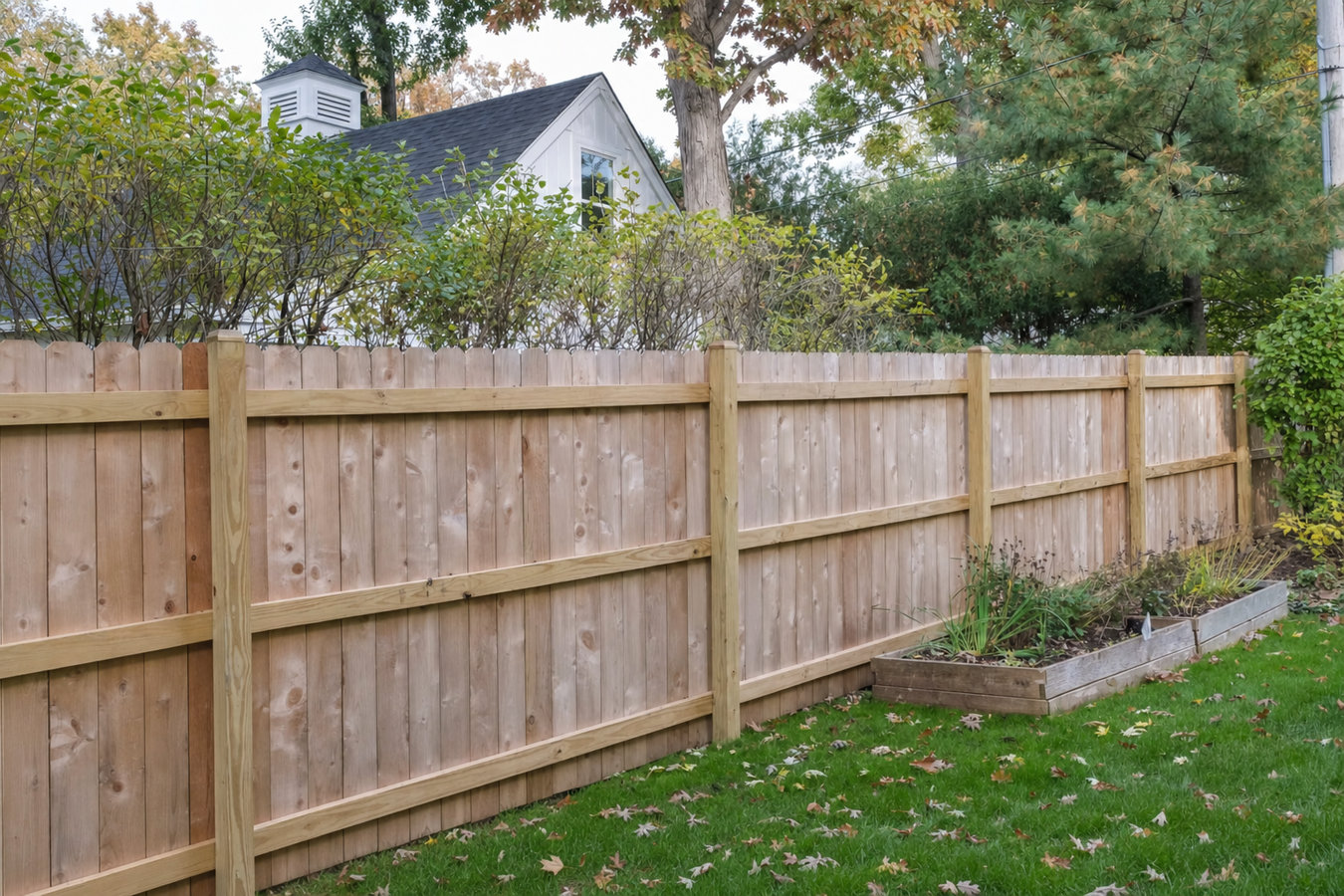
A properly built wood privacy fence with deep concrete footings stands up to Royse City storms and clay soil - giving your yard a defined, private space that holds its shape for years.
Wood and privacy fence installation in Royse City means digging post holes, setting concrete footings, framing horizontal rails, and attaching vertical boards along your property line - most standard residential backyards are completed in one to two days of active installation, with permitting adding time before the crew arrives.
Wood is a common first choice because it costs less upfront than vinyl and can be built to almost any height or style. The trade-off is that it needs maintenance - sealing or staining every three to five years is what keeps a wood fence looking good and standing straight through Royse City's hot summers and occasional hard freezes. Skip that maintenance and the wood dries out, grays, and cracks faster than you would expect in this climate. If you want to compare the long-term picture, our vinyl fence installation page lays out the differences clearly so you can decide what fits your situation.
What determines how long any wood fence lasts is not the boards you can see - it is the posts underground. In Royse City's Blackland Prairie clay, posts that are not set deep enough will start to lean within a few years as the soil swells and shrinks with the seasons. Getting the foundation right is the job. The privacy and appearance above ground are what you get when it is done properly.
Give each post a firm push along your fence line. If it moves or rocks, the post has either rotted at the base or the concrete footing has failed. In Royse City's clay soil, this happens faster than in sandier ground because the soil expands and contracts around the post year after year. A wobbly post is not cosmetic - it means the whole fence section is at risk of coming down in the next strong storm.
Wood that has never been sealed or stained will turn gray and start to split within several years in the Texas heat. If you can see daylight through gaps that were not there when the fence was new, or boards are bowing outward, the wood has dried out past the point where a coat of stain will fix it. This is especially common on fences that face west or south and take the full afternoon sun.
A fence that worked fine as a property marker may not be adequate to keep a dog in or a child away from a pool. If your current fence has gaps at the bottom, gates that do not latch securely, or sections that could be pushed through, it is time to replace or upgrade rather than patch.
Royse City HOAs do periodic inspections and will send notices about fences that no longer meet community standards. Home inspectors also flag fence condition in their reports - buyers sometimes use it as a negotiating point. Acting on your own schedule is less stressful and less expensive than responding to a deadline.
Every wood fence build starts with the permit and ends with a walkthrough of the finished fence before we leave. We handle utility line marking through Texas 811, post-hole digging and concrete setting, rail and board installation, and gate hanging with hardware rated for daily use. Wood species matters in this climate - cedar naturally resists rot and insects without chemical treatment, which makes it the better long-term choice for most homeowners. Pressure-treated pine costs less upfront and is a solid option for those who plan to maintain the fence regularly. We walk you through both options and give you a straight answer on which fits your budget and goals. If you are thinking about more than just the fence line - screening in a porch, for example - take a look at our screened-in porches and screened decks page.
If you have an existing fence that needs to come down first, we handle removal and disposal as part of the job. We also review HOA guidelines before any work begins - Royse City's newer subdivisions often specify fence height, the direction the finished side must face, and in some cases the type of wood allowed. Getting written HOA approval before we start means the fence passes inspection the first time and you never get a letter afterward.
Best for homeowners who want natural rot and insect resistance built into the wood - cedar holds up longer with less maintenance than pine in the Texas climate.
The lower-cost option that still performs well when built correctly - good for homeowners who want a solid privacy fence and plan to seal or stain it regularly.
Alternating boards overlap to eliminate gaps while still allowing air to pass through - a popular HOA-approved style throughout Royse City's newer subdivisions.
Single or double drive gates built with reinforced posts and hardware rated for daily use - the detail that separates a fence you can trust from one that sags open on its own.
Royse City sits on the Blackland Prairie, a stretch of heavy clay soil that covers Rockwall County and a large part of North Texas. That clay is the defining factor in how any fence performs over time. It swells after rain - sometimes visibly lifting the ground - and then contracts during dry spells, which can last for months in a North Texas summer. Every cycle puts stress on fence posts. Posts that were set at a standard depth may hold through the first few seasons and then start to lean once the cumulative movement adds up. We account for this by setting posts deeper and using adequate concrete to anchor them through the cycle. Homeowners in Greenville and Wylie deal with the same soil conditions, and we build the same way across the service area.
Beyond the soil, Rockwall County sits in a spring storm corridor that sees strong thunderstorms, hail, and straight-line winds with regularity. Royse City's newer subdivisions are built on flat, open lots with little natural windbreak, which means a fence takes the full force of those storms. This is another reason post depth and concrete anchoring matter more here than they might in other parts of the country. The city's rapid growth also means most neighborhoods have active HOAs with specific fence rules - height, style, finished-side direction, and sometimes wood species - and the permit process through the City of Royse City applies to nearly all residential fence installations.
We will ask a few quick questions about your yard - how much fencing you need, whether you are replacing an existing fence, and whether you have an HOA. We respond within one business day and can schedule a free on-site visit at a time that works for you.
We walk the fence line with you, take measurements, and look at grade changes, tree roots, and proximity to utility lines. You receive a written estimate breaking out materials and labor - not a rough number over the phone.
We handle the City of Royse City permit process and, if your neighborhood has an HOA, help you submit for written approval. This step can add one to two weeks before work begins - we handle the paperwork and keep you updated throughout.
We call 811 before digging, set posts in concrete to the depth Royse City clay demands, attach rails and boards, and hang gates. Most backyard fences are done in one to two days. We walk the finished fence with you before leaving.
Free written estimate, no obligation. We respond within one business day.
We set posts at depths suited to the Blackland Prairie clay in Royse City - not a one-size number from a general installation guide. The concrete and depth we use are what keep posts from leaning after the first few wet-dry cycles. Texas A&M AgriLife Extension documents the specific movement characteristics of Blackland Prairie soils.
We pull the City of Royse City permit and, when needed, help you get written HOA approval before a single post goes in the ground. You make one call - the paperwork and coordination are on us.
Rockwall County's spring storms can bring straight-line winds over 60 mph. Our post-setting and anchoring process is designed with those conditions in mind - because a fence that cannot survive Royse City weather is not built correctly.
Every job starts with a written, itemized estimate that breaks out materials and labor. We do not add charges without talking to you first - the number you agreed to is the number on the final invoice.
The combination of proper post depth, permits handled, and HOA approval secured before work starts is what keeps homeowners from dealing with leaning fences, violation notices, or billing surprises after the job is done.
Extend your outdoor living beyond the fence line with a screened porch that keeps bugs out and usable space in year-round.
Learn MoreThe no-maintenance alternative to wood - PVC privacy fencing set on the same deep concrete footings we use for every fence job.
Learn MoreSpring books fast in this area - reach out now to get on the schedule before the busy season fills up.